Arcade vs Storylane: interactive demo platforms compared
Arcade charges per seat and has turned to AI video. Storylane charges per plan and sells to sales teams. Prices and limits as of November 10, 2026.
By the tday team Published 5 min read
The short answer
Both make click-through interactive demos, and both are free for one published demo. They differ in who they are for. As of November 2026, Arcade charges per seat, $50 a month on Growth, and its site now leads with AI video for marketing teams. Storylane's Starter is $50 a month for one seat, with extra seats listed at $40, and its next plan, Growth, is $625 a month for five. Storylane's Growth plan includes HTML demos you can edit after capture. On Arcade that is Enterprise only.
Key takeaways
- Both free plans allow 1 published demo with a watermark. Storylane's adds 200 AI credits.
- Both entry plans cost $50 a month. Arcade's is per seat, up to 10. Storylane's includes 1 seat, with extra seats listed at $40 each.
- The gap opens above that: Storylane's next plan is $625 a month ($500 billed yearly) for 5 seats. Arcade's is Enterprise.
- HTML demos start on Storylane Growth. On Arcade, HTML capture is Enterprise only.
- Storylane's MCP server can build a demo from images, a video or a URL. Arcade's cannot create or edit interactive demos.
Accurate as of . Every fact about Arcade and Storylane was read from their own websites that day, and each page is listed under Sources. Prices and plans change, so check the vendor's page before you buy. tday publishes this blog. Neither product here is ours.

Arcade and Storylane get compared because they do the same basic thing: record a flow in your browser, publish a demo people can click through. Around that they have grown in opposite directions.
Arcade grew toward creators. It is priced per seat, and in October 2026 it made AI video its main product. Storylane grew toward sales teams. It is priced per plan, with deal rooms, account reveal and an AI agent for your website. Knowing that tells you most of what the feature table will say.
Arcade vs Storylane at a glance
This table compares the interactive demo products. Arcade's AI video and Storylane's RepX agent are each priced separately.
| Arcade | Storylane | |
|---|---|---|
| Free plan | 1 seat, 1 published demo, with a watermark | 1 seat, 1 published demo and 200 AI credits, with a watermark |
| Entry plan | Growth: $50 per seat a month, $42.50 billed yearly, up to 10 seats | Starter: $50 a month, $40 billed yearly, for 1 seat. Extra seats listed at $40 each |
| Next plan | Enterprise, custom price | Growth: $625 a month, $500 billed yearly, for 5 seats |
| HTML demos | Enterprise only | Growth and up |
| Editing captured HTML | Enterprise only | Growth and up: change text and swap images without recapturing |
| AI voiceover | Every plan, in 29 languages | Every plan, using AI credits. 60+ voices in 25+ languages |
| Exports | MP4 and GIF on Growth, up to 720p | MP4 on Starter and up. GIF, PDF and document exports on every plan |
| Lead forms | Growth and up | Every plan |
| CRM | HubSpot on Growth. Native Salesforce on Enterprise | HubSpot on Starter. Salesforce on Premium |
| Desktop app | Mac and Windows | Mac and Windows, on every plan |
| MCP server | Reads demo analytics and makes AI videos. Cannot create or edit demos | Builds demos from images, a video or a URL. Starter and up |


Where Arcade is the better choice
Translations and branching at the entry price. Arcade's Growth plan, at $50 a seat, includes AI translations and demo branching. Storylane offers translations on Premium and above, by request, and we found no branching feature in its docs.
You want video as well. Arcade's main product builds marketing videos from a description. It is a separate subscription under the same login.
Where Storylane is the better choice
HTML demos. A screenshot demo is a picture of your product. An HTML demo is a copy of the page, so you can change a name, a number or a logo after capture. Storylane includes this from Growth, with search and replace across the demo. Arcade lists HTML capture under Enterprise.
Selling. Lead forms and basic analytics are on the free plan. Starter adds account reveal for 250 visitors a month. Premium adds deal-room Hubs and Salesforce.
An assistant that builds. Through Storylane's MCP server, Claude, ChatGPT or Copilot can turn images, a video or a URL into a demo. Arcade's docs say its server cannot create or edit interactive demos.
Keeping demos current
Both expect you to do this by hand today. Storylane's sandbox page says you "recapture the screens that changed rather than rebuilding the demo". In an HTML demo you can also fix the text in place.
Arcade announced an agent that re-captures a flow for your review on December 3, 2025. Its post still points to a waitlist, and its docs do not describe the agent.
One claim worth correcting: we found nothing on Storylane's site about rebuilding demos from staging when you deploy.
What each one costs
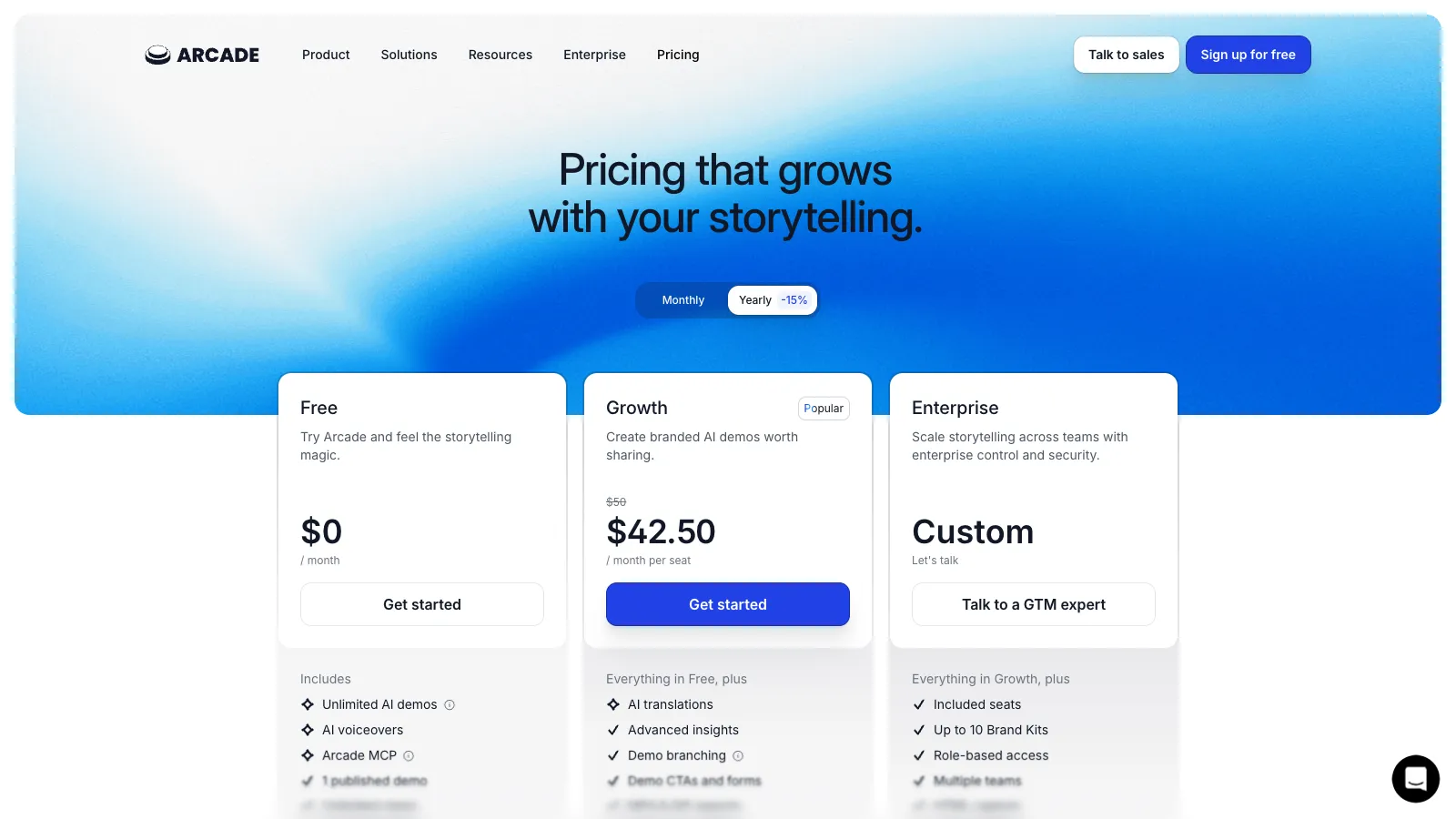
Arcade has two paid levels for demos: Growth at $50 per seat a month ($510 a seat billed yearly), for up to 10 seats, and Enterprise. Five people on Growth pay $250 a month.
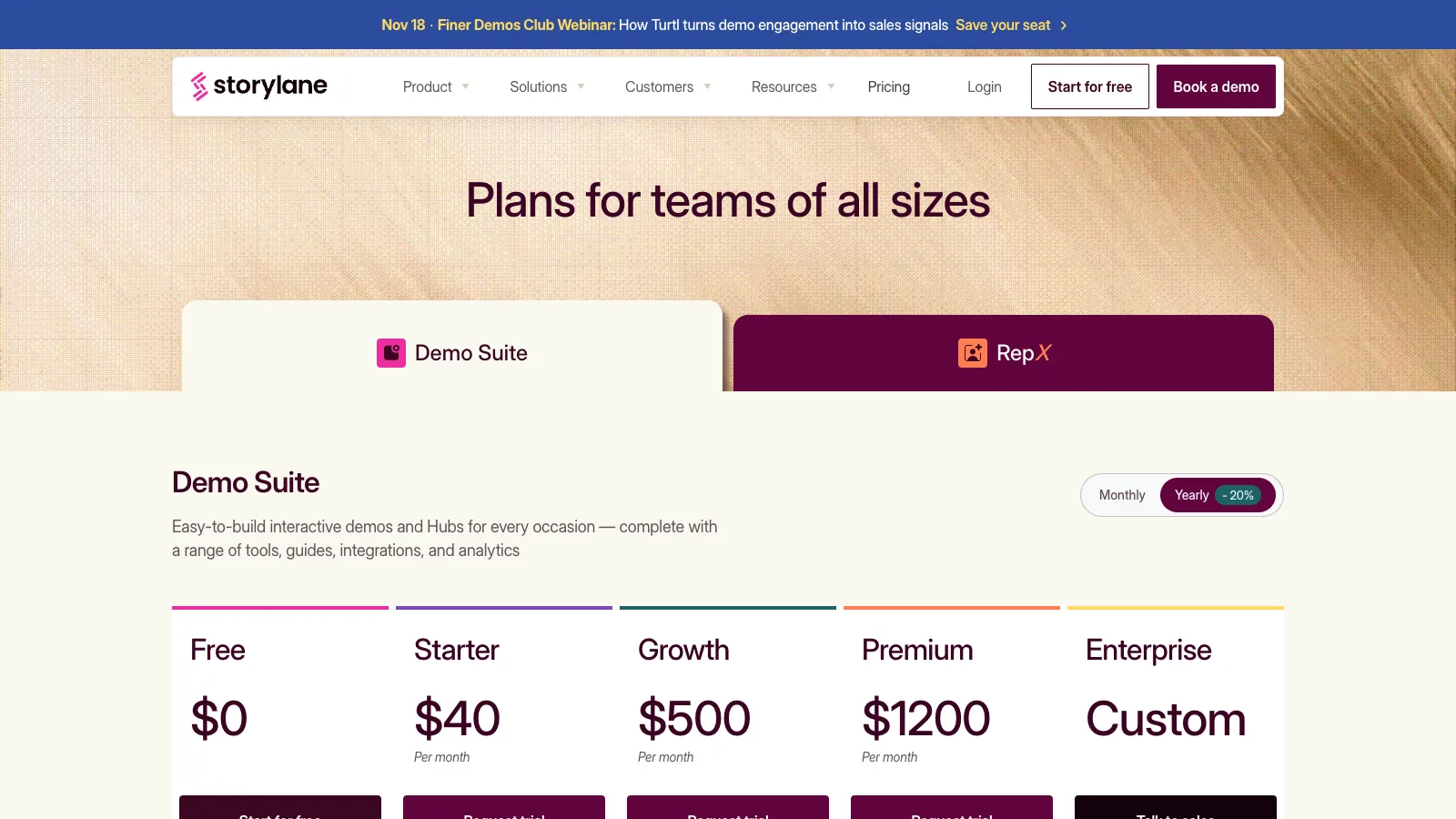
Storylane has four. Starter is $50 a month, or $40 billed yearly, with one seat. At its listed $40 for each extra seat, five people pay about $210. Growth is $625, or $500 billed yearly, with 5 seats and 10,000 AI credits. Premium is $1,500, or $1,200 billed yearly, with 10 seats. Enterprise is custom.
The number to notice is the step from Starter to Growth: $50 to $625. If you need HTML demos, that is the price of entry on Storylane, and on Arcade it is a sales call.
Which should you pick
For a small team making screenshot demos for a website or a changelog, either entry plan works, and the price is about the same. Pick Arcade for translations and branching, Storylane for lead forms and account reveal.
For a sales team that wants HTML demos, lead data and CRM sync, Storylane is built for exactly that, and priced like it.
Both are for demos a viewer clicks. For a narrated video that a coding agent records and re-records as the product changes, see tday vs Arcade.
Frequently asked questions
Is Storylane more expensive than Arcade?
At the entry level they are about the same: $50 a month as of November 10, 2026, per seat on Arcade and for the first seat on Storylane, where extra seats are listed at $40. Storylane's next plan is much more: Growth is $625 a month ($500 billed yearly) for 5 seats, and that is where HTML demos start. Arcade's only plan above Growth is Enterprise, at a custom price.
Do Arcade and Storylane have free plans?
Yes. Both allow 1 seat and 1 published demo for free, with a watermark. Storylane's free plan also includes 200 AI credits, lead capture and basic analytics. Both include AI voiceover.
Which supports HTML demos, Arcade or Storylane?
Both, on different plans. Storylane includes HTML demos from its Growth plan ($625 a month, or $500 billed yearly). Arcade lists HTML capture on its Enterprise plan only.
Does Storylane rebuild demos automatically when the product changes?
No. As of November 10, 2026 Storylane's site says you recapture the screens that changed, and that HTML demos can be edited in place. We found nothing on its site or changelog about a rebuild triggered by a deploy or a staging environment.
More comparisons
tday vs Arcade
Arcade now sells AI video for marketing teams, with interactive demos priced separately. tday records your real app. What each costs as of November 10, 2026.tday vs Loom
Loom records you explaining something. tday has your coding agent record the product. What each is for, its limits and its price, as of November 10, 2026.tday vs Screen Studio
Screen Studio polishes a recording you make on a Mac. tday has your coding agent make the recording. Features, limits and prices as of November 10, 2026.tday vs Tella
Tella is a studio for videos you present. Its agent films web apps on public domains. With tday, your coding agent films localhost too. November 10, 2026.tday vs Supademo
Supademo makes click-through demos from screenshots. tday makes narrated videos your coding agent records. Features and prices as of November 10, 2026.Arcade vs Supademo
Both sell interactive demos at $50 a seat. Arcade has since turned to AI video. Supademo gives more for free. Plans and limits as of November 10, 2026.Loom vs Screen Studio
Loom gets a link to a teammate in seconds. Screen Studio makes a recording look produced. Platforms, features and prices compared as of November 10, 2026.Screen Studio vs Tella
Screen Studio polishes one recording on a Mac. Tella builds a video from clips on Mac, Windows or the web, and hosts it. Compared as of November 10, 2026.Loom vs Tella
Loom is for quick videos to people you work with, and has a free plan. Tella is for videos you publish, with automatic zoom. Compared as of November 10, 2026.


Or see all of them at once: The best demo video tools for developer-led startups in 2026, compared.
Sources
- Arcade, Arcade
- Arcade interactive demo pricing, Arcade
- Plans and AI credits, Arcade
- Exports, Arcade
- Arcade MCP, Arcade
- Arcade translations, Arcade
- Arcade changelog, Arcade
- Meet Arcade's new Creator Studio, Arcade
- Storylane plans, Storylane
- Recording HTML demos, Storylane
- Editing HTML screens, Storylane
- AI demo creation, Storylane
- Storylane translations, Storylane
- Storylane MCP overview, Storylane
- Storylane MCP demo tools, Storylane
- Sandbox demos, Storylane
- Storylane desktop app, Storylane
Have your coding agent record your first demo
One prompt in Claude Code, Cursor or Codex records a narrated demo of your app. tday voices, styles and renders it, ready for your docs. Free includes 5 saved demos.